
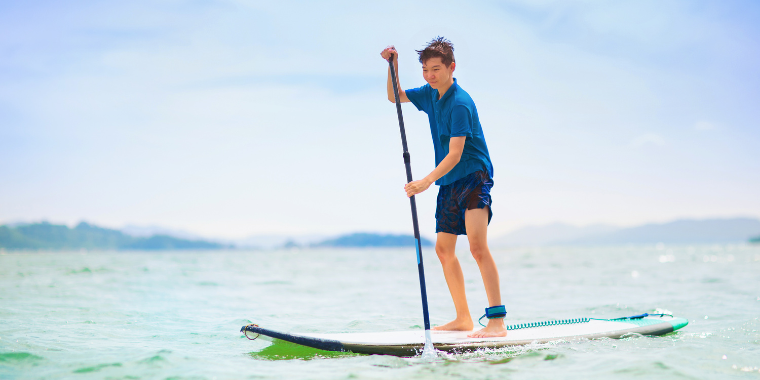

Finding Your Balance:
Imagine stepping onto your paddle board for the first time, eager to explore the waters, but soon you’re wavering side to side, struggling to find your footing. Maintaining the right balance is essential for a smooth paddle boarding experience. Many novice paddlers often misjudge their stance, causing unnecessary instability. Common paddle boarding mistakes include standing too far back, which can lead to tipping over, or too far forward, which can create unnecessary strain on your lower back.
To avoid these pitfalls, it’s important to adopt an effective stance. Position your feet shoulder-width apart and keep your knees slightly bent. This simple adjustment can provide the balance needed to glide effortlessly across the water. If you’re still finding it hard to maintain balance, consider practicing on land first to get a feel for the board’s stability before pushing off into deeper waters. You could also heck out our best inflatable paddle boards for beginners to find a board designed for stability.
Improper Paddle Technique:
One of the most frequent mistakes when paddle boarding is using an incorrect paddle technique. Novice paddlers often apply too much force or paddle with the wrong angle, leading to fatigue and potential loss of control. When your paddle stroke lacks efficiency, you may tire quickly, detracting from the pleasure of the experience.
To steer clear of these issues, focus on using a relaxed grip and maintaining the correct angle of the paddle. Your arms should remain straight at the beginning of the stroke, and you should engage your core to power through the water. Practicing proper stroke technique will not only help you navigate more effectively but also allow you to enjoy longer sessions without unnecessary fatigue. Learn more about choosing the right SUP paddle to ensure optimal performance.
Safety Precautions:
Many beginners overlook the importance of safety while paddle boarding. Ignoring safety gear, such as wearing a personal flotation device (PFD), can lead to risky situations, especially for novice paddlers who may not be fully confident in their abilities. In addition, familiarising yourself with water conditions and local regulations is a commonly overlooked safety precaution.
Before you head out, ensure that you have all of the essential SUP safety equipment and check the weather for any changes. Understanding the conditions will help you gauge whether it’s a suitable day to paddle. Always remember that safety is not just about wearing gear; it also involves being cautious and mindful of your surroundings, especially in a new environment. For more tips, refer to the RNLI’s paddle boarding safety guidelines.
Pacing Yourself:
In the excitement to explore, beginners might make the mistake of overdoing it, trying to paddle longer distances than they’re comfortable with. This can lead to exhaustion or accidents on the water. It’s easy to get caught up in the enjoyment but knowing your limits is an essential paddle boarding tip for beginners.
Start slow, take breaks, and be attentive to your body. If you find yourself feeling fatigued or unsteady, it’s perfectly fine to pause and catch your breath. This practice not only promotes safety but also ensures you enjoy your experience rather than rushing into challenges. Embracing a steady pace helps you learn control and build confidence gradually, making your paddle boarding journey a more enjoyable one. Check out tips for beginner paddlers from Go Paddling for more guidance.
Pre-Launch Preparations:
Another common mistake beginners make is skipping essential pre-launch preparations. This can lead to challenges once you’re already on the water and can also heighten the risk of accidents. Tasks such as checking your paddle board, making sure the paddle is the correct length, and having your safety equipment can transform your experience.
Take the time to practice balancing on dry land before hitting the water. This will enhance your comfort level and allow you to focus on technique rather than balance when you’re on the water. Remember, the more prepared you are before launching, the smoother and more enjoyable your paddle boarding adventure will be.
Building Confidence and Skills: Actionable Tips for Your Paddle Boarding Journey
As you embark on your paddle boarding journey, confidence is key. Practicing essential drills will help enhance your skills and foster a sense of assurance on the water. Start with simple maneouvers and eventually progress toward more complex strokes as you gain comfort.
Mindfulness can also be an incredible tool for building confidence. Focus on the present moment, concentrating on your breathing and the rhythm of the water. This practice not only helps improve balance and control but also enhances the enjoyment of your time on the water.